Sunday, November 8, 2009

Pulling: Redux

Dulling the Axe

Most of my pulling discussions tend to be oriented toward /RDM -- not because /NIN is the devil, but because that's what I use and that's what I have fun doing. I'm not out to convert the world to /RDM. In this post, I'd rather stress the importance of the strategies that come into play when you're out to have fun while you're meriting, and the easiest ways I've found to make the transition between looking for parties and having parties look for you.

Axioms


A short set of social rules that seem to apply to every party and pulling situation:

If you take the initiative to make the party:
1. You can pull however and wherever you like.
2. You can take only people you know, and -- if you want -- only people you like.
3. You can party as long (or as short) as you like.

If you seek party:
1. You might have to advocate for your pulling strategy, or for a particular camp.
2. You'll take who you get.
3. You can still party as long as you like, but whether or not it's fun is mostly up to chance.

You can pretty much guess which situation I favor for this one.

The easiest way to have fun while you merit is to get a group together from your linkshell or to build an extensive flist of people you like to exp with. You can also ask for recommendations from your friends and try to merit in parties that are at least half composed of people you already know and like.

There's nothing breakthrough about this strategy, but I'm always surprised by how many people complain about meriting when all they do is look for parties ... instead of building their own.

Constructing a Group

Caveat: Situational. There are plenty of guides out there to exp camps. I deal mostly with merit-burn style parties.

1. A good healer. I don't like inviting healers I don't know, because a bad one will be the death of you.

2. A corsair. Not absolutely necessary, but it's good to build up a list of corsairs that you like and that like you back -- if you see one you like out in thickets, strike up a conversation, flist them, and invite them to your next group if they're amenable.

3. DD. Almost anyone will do, and I'll invite anyone if I like their company enough. Flist the ones who impress you in your best parties. If you have three strong DD, it's possible to have a good merit party with only five people (healer, bard, ddx3). If you have weak DD, it's usually better to have more/four of them and skip the corsair.

4. You. Bring pulling food of choice and your preferred subjob. Being consistent in choice of camp, pulling methods, and party setup will make actually pulling less of a hassle for you.

You'll find that the people you like will tend to make parties you like -- and that by having an extensive flist, you'll never lack for good invites. That can be both good and bad.

Good: you'll always have nice people to merit with.
Bad: they'll never stop inviting you. Ever.

Etiquette

There are pulling manners.

1. Make sure you (the pulling bard) or your leader have your camp in your seacom. All but the most rude people will check seacoms before they go to a camp. If someone doesn't have their camp commented, I consider it open -- though sometimes I'll make an effort to ask the leaders where their parties are, individually.

2. If you need to pull extra mobs from an area normally patrolled by another party, talk to their puller before you do. You might be able to come to a compromise without breaking either group's exp chain.

3. Wait for all party members to arrive before beginning a chain.

4. This is optional. Break the exp chain and restart when someone new arrives. This is a particularly odd bit of courtesy that some of my long-time friends appreciate. I prefer to ask new arrivals if they'd like me to break chain and restart for them, rather than breaking chain without explanation.

5. At bird camp -- middle or bottom -- do not pull birds from the other level, respectively, without express permission from the other puller. If you do it accidentally, tender an immediate apology to avoid the other puller embarking on a revenge-pulling contest. Most people won't care, but it's the rare few who do that will end up driving you up a wall.

6. Handle any special requests at the beginning of the party. This is why it pays to merit with people you know -- they already know what to expect from you and how you like to pull. I like my melee to kill whatever I pull first, links second. They know that and it's easier for them to make up their minds about a target in a link situation. If all else fails, designate an /assist.

Moral Gray Areas

That would be taking occupied camps or fighting off someone else who is trying to occupy your camp. I've arrived at a camp at the same time as another party, before -- but that's very rare. The usual rule is that the place belongs to whoever is there first and whoever is pulling mobs first. Whether or not you adhere to those unwritten rules is up to you.

The best way to take a camp and keep your reputation intact is to arrive and just begin pulling. Taking a camp is not and never should be a personal matter -- just business, getting yourself and your group some exp. Some people will never camp on other people no matter the situation.

Camping on another group tends to be less of an issue these days, with smnburn, chigoeburn, and increasing camp options. It used to be a much bigger problem, and part of my reason for pulling /RDM was an increased ability to both outpull another party and to defend my camp from people who tried to move in (while it was commented, no less).

I'd like to stress that this is only sometimes an issue at merit camps, but it's something that's bound to happen to everyone at least once in their career. What you do about it is up to you. FYI: there's nothing in the ToS that will give you footing with a GM, so it's up to the players to work/fight it out. XD

End Notes

These are just suggestions for forming and maintaining healthy merit parties. I leave pulling style and camp up to individual choice. It's my hope that the etiquette list will be particularly useful for new bards who may not yet know the implicit code of conduct. Adhering to a personal code will make it easier to compromise with other pullers in your area and will also make you a known quantity to other bards and other people who are frequently meriting near you in the same camp. Unless you like annoying other people and being annoyed in return, following the suggestions in the etiquette list will tend to keep your camps clear and your groups productive.

Friday, September 18, 2009

Elegy Duration - Part Two

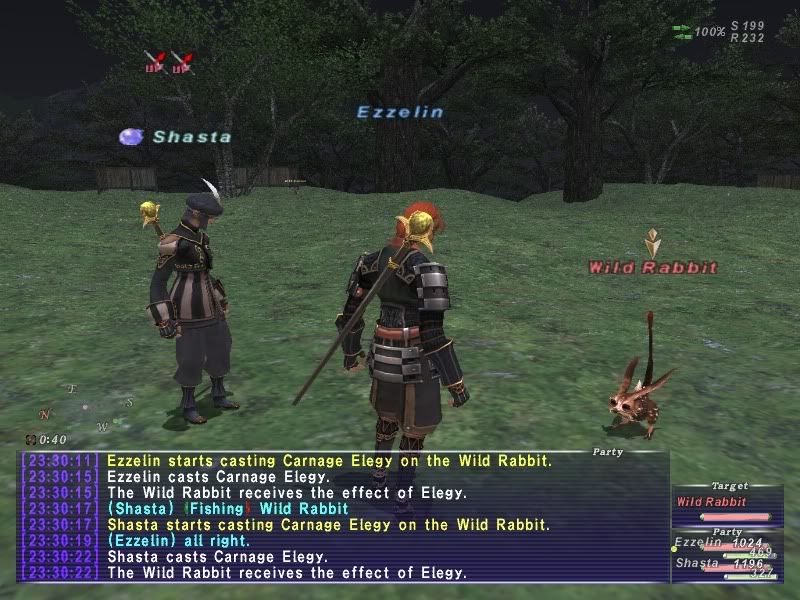
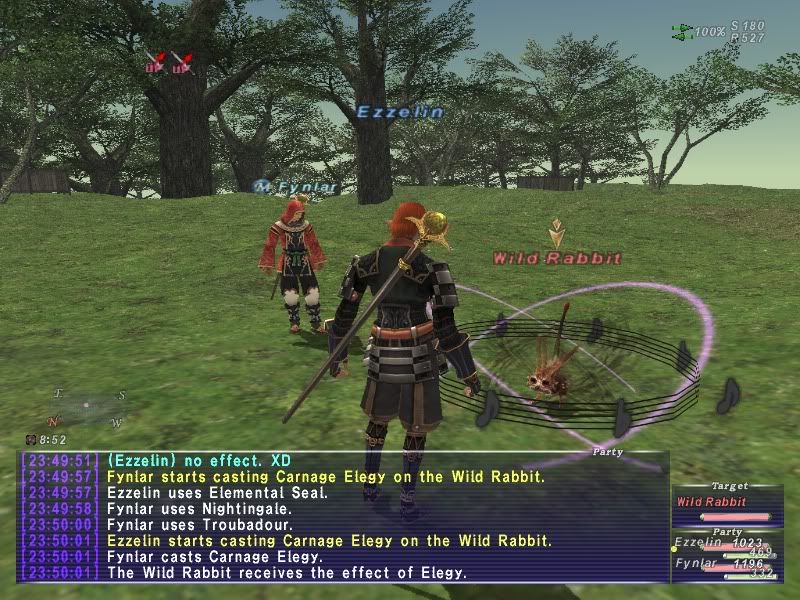
Went out and did some quick tests on Wild Rabbits in E.Ronfaure.

---
Baseline

Elegy duration in normal gear with Horn+1: ~212 seconds (so at or a little over 3:30)

Predicted duration of night/troub elegy: ~420 seconds (about 7mins).
Actual duration: ~429 seconds

---

Testing

I saw some questions about log messages regarding a non-JA elegy landing when a JA-elegy was already up on a mob. I started by casting Night/Troub Elegy on the rabbit, letting the JA's wear off, then checking the log again when casting with a normal elegy.

Final elegy duration when casting in the first half (first 200-212s) of the elegy window: 275s (4:30)

Conclusion: Non-Night/Troub elegy overwrites Night/Troub elegy (otherwise I'd have seen the longer 7:00min duration rather than the shorter 4:30 duration) -- at least if it comes from the same bard. o-o!

---

In theory, this should not happen.

A shorter-duration elegy shouldn't overwrite a longer-duration elegy, if debuff priority works the same way that buff priority does. So, I tried the test again -- this time enlisting the help of a fellow bard.


Predicted duration: ~4:30 (270s)
Actual elegy duration: ~4:44 (314s)


Conclusion
: Any bard can overwrite any other bard's elegy, regardless of remaining duration.

And then I got another friend to come out to join us, this time to test Soul Voice.


Predicted duration: ~4:30 (270s)
Actual duration: ~4:56 (296s)
Note: For this test, non-SV'd bards got 'no effect' messages against his SV'd elegy. However, he was able to overwrite his own SV Night/Troub'd Elegy with a non-Night/Troub'd (but still SV'd) elegy.

Conclusion: Soul Voice'd Elegy has priority over any other elegy, regardless of duration. However, Troub+SV elegy can be overwritten by just a normal SV elegy. Casting elegy while an SV elegy is up will result in a 'no effect' message.

---

Why This is Important


Debuff duration priority does not work the same way that buff duration priority does! A shorter duration song -- and presumably a less potent one -- can overwrite a longer duration song.

Casting elegy after someone else has, and not getting resisted, does not mean that the previous elegy was either resisted or any less potent. It just means that your elegy landed and overwrote the previous elegy. So!

To answer the question posed here:

Casting random elegies at Khimaira is probably a bad idea.

People should just be taking turns, and letting the other bards know when they get a "Khimaira's Elegy wears off" message. This ensures that only Night/Troub'd elegies (hopefully with ES!) will stay on. The last thing you want is to land an elegy that wears off 1:30 later ... when your ES/Night/Troub bard's elegy has only been on for about :30.


IMPORTANT: At the moment, I have not yet had the opportunity to test that this effect is also true on HNMs. However, I don't believe that I'll see any difference.

Saturday, September 5, 2009

Links of Interest

Because it's best to read many different opinions. These are circa 2008ish, but still mostly correct on the very old M.Acc vs. Skill vs. CHR debate.

The whole LJ blogroll, for your entertainment (and there are some funny situations and pictures in there).

The notes on Paralyze aren't new and aren't groundbreaking.

Next post: The history of the Skill vs. M.Acc vs. Stat debate.

Wednesday, September 2, 2009

Why is my Lullaby resisted?

Common question! Here's a fun way to find the answer:

1. Are you using a horn or a harp? If horn, go to (2). If harp, go to (10).
2. Is your combined wind+singing skill more than 450? Lower than or equal to 450, go to (3), higher than 450, go to (4).
3. You probably need more +Skill. I suggest Choral Cuffs/Cannions (NQ or +1), Bard's Roundlet/Marduk Tiara, Wind Torque, Nereid Ringsx2, or Oracle's Pigaches. If you still get resists, and your combined skill is above 470 or so, go to (4) -- otherwise keep adding any skill gear.
4. Are you using a Light Staff or an Apollo's Staff? Light, go to (5), Apollo's, go to (6).
5. Get an Apollo's staff. If you're still seeing resists, go to (6).
6. Check your CHR stat. Is it in the ballpark of 110-120? If yes, go to (8), if no, go to (7).
7. Equip some more CHR gear. Kirin's Osode or Errant body is good for this. As is Gleeman's Belt, Jester's Cape +1, and the Omega Ring. If you still get resists, go to (8), if not go to (9).
8. Congratulations, you have all the gear and the stats ... but the mob is probably resistant or immune to lullaby. D: Resistant things tend to take very high levels of skill and/or CHR to lullaby reliably (480-500+ skill, roughly). Try your best!
9. Congratulations, problem solved! :D
10. Is your combined string+singing skill more than 450? Lower than or equal to 450, go to (11), higher than 450, go to (4).
11. Try adding some String skill gear. The String Torque is cheap. If you still get resists, go to (13), if not, go to (9).
12. You probably need more +Skill. I suggest stacking singing where possible. Choral Cuffs (NQ or +1) and Bard's Roundlet/Marduk Tiara offer the weightiest bonuses. If you still get resists, go to (8). If you rarely get resists now, go to (9).
13. Check your CHR stat. Is it in the ballpark of 110-120? If yes, go to (8), if no, go to (7).

---
Note: M.Acc isn't included much in the key. But it's also helpful on resist rates. Buying an Apollo's Staff has a very noticeable effect on how often your Lullaby is resisted. I always suggest upgrading to the HQ before buying any other gear.

---
Sometime in the future:
BRD on a Budget - or - What to buy if you don't buy anything else.

Foe Requiem

I saw some questions about this, and very few answers.

This is the wiki's take.

Not very informative, is it?

Let me begin by asserting that I have no concrete numbers to back up my assumptions -- but I can compare with other tiered songs. For example -- singing Army's Paeon V produces a 5-tick regen effect. Singing it with a +2 Paeon instrument produces a 7-tick regen. I assume that Foe Requiem's damage is calculated in a similar fashion. Thus:

FR I = -1 (-3)
FR II = -2 (-4)
...
FR VI = -6 (-8)
*Numbers in parentheses represent the effect of using a +2 Instrument.

It's reasonable to assume that Requiem works in this fashion. I am fairly confident that Soul Voice doubles the effect of Requiem (it is particularly useful to halt the regen of unclaimed Poroggo Madames, does a fair bit of damage to Salvage chariot bosses, and has applications in Limbus/Nyzul Isle with an active Korin Obi).

Application
Assume that landing Requiem is a lot like landing Elegy. Use an HQ staff if you have it -- they're the best gear money can buy for resists -- and use a combination of Skill, M.Acc, and CHR where available. The effect of Skill tends to be more noticeable than the effect of CHR, and I don't have enough M.Acc to comment. With the +32 of merits, I can reliably land Requiem on targets that are neither light resistant nor immune*. If you have trouble landing Requiem, try putting on more Skill or M.Acc gear.

BRD has no natural enfeebling skill, so it's safe to assume that Enfeebling Magic Skill has nothing to do with songs. M.Attk is known to affect BLM nukes, but there's no evidence that ties it to the effectiveness of an enfeebling song like Requiem.

Bard song effects tend to be constant, anyway -- with the notable exception of Etudes, whose effects decay over time.

---
*My stick rate on Poroggo Madames tends to suffer if I haven't unlocked my Apollo's Staff, for example.

---

Additional Reading:
Discussion on BG