Showing posts with label faq. Show all posts

Sunday, April 4, 2010

Questions About Magic Accuracy

Add this to the list of things I really should have just written a blog post about...

The original post from Alla, titled 1 CHR = 1 Magic Accuracy = 1 Skill?

And my response, beginning with a quote from the original post:
Lets assume we are against a target with high CHR (think HNM). So we are well below the CHR+10 mark. If this article is correct that means in this situation: 1 CHR = 1 skill right? In other words this article values CHR more then we currently do, am I right?

And the last time you met a BRD HNM was---?

You'll find that direct elemental resistance and innate song resistance matter more than relative stat levels in the HNM scene. No matter how good your debuffing setup is, you'll never land elegy on ouryu (ice threnody, however...). No matter how good your debuffing setup is, you'll have trouble landing elegy on ToAU kings without elemental seal.

Disclaimer Follows

WARNING: Asmoranomar's above analysis is essentially correct. Only keep reading if you'd like a more detailed conceptual comparison, and a bit more insight into why it may be worthwhile for you to pick Skill/Macc over CHR. My usual debuffing setup, for example, works with 89 CHR total (including merits).

Conceptual Analysis

So! Breaking down the logic of the initial analysis:

Tests show show that 1 magic accuracy = 0.5% magic hit rate below 50% hit rate, 1.0% increase after 50% magic hit rate.

it also shows 1 skill = 1 magic accuracy and for stats such as INT = 1 magic accuracy until total int is >targetINT+10. Each additional point of INT after that gives 0.5 magic accuracy. It is unknown if any amount of stats after that limit can give 0.5 magic accuracy. It is assumed the same goes for MND vs TargetMND and CHR vs TargetCHR.


We're talking about two different things here: "Magic Accuracy" and "Magic Hit Rate."

The goal of the test that wiki references was trying to model the relative relationship between Skill, Magic Accuracy, and STAT as stats that contribute to a general "Magic Accuracy" number.

"Magic Hit Rate" -- again citing otherwiki for kicks -- is apparently determined by a check between the caster's Magic Accuracy stat and the target's Magic Evasion stat. Magic Evasion is extremely important in any discussion about M.Acc.

Important points about Magic Evasion: It can vary by target and by spell. Magic Evasion is one reason you will never land paralyze on a UFO in sea, even though it's weak to ice-based magic. UFOs are arbitrarily immune (and/or have extremely high magic evasion) to the specific spell. Wiki uses imp resistance to sleep but not to gravity as another example.

So. What does this mean for BRD? Assuming the model is anywhere near true in a conceptual sense:

1. CHR = 1 magic accuracy until total CHR is >targetCHR+10. Each additional point of CHR after that gives 0.5 magic accuracy.

2. 1 magic accuracy (or 1 skill) = 0.5% magic hit rate below 50% hit rate, 1.0% increase after 50% magic hit rate.

Again we're not talking the same stats. Let's assume we have an HNM target with high CHR and a naturally high ME stat on Elegy.

In this situation 1 CHR = 1 Macc the whole time, because we never hit the >targetCHR+10 stat. HOWEVER, that still only contributes 0.5% magic hit rate overall -- because our general hit rate is still below 50%. CHR and Macc end up equalized by the pressure of high magic evasion. I have no idea if Khimaira has high CHR for example, but that doesn't matter because his magic evasion on elegy is so high! Elemental Seal directly increases caster Magic Accuracy by some amount (no one knows how much) -- but it makes Elegy pretty much unresisted, which is why bards /BLM at Khimaira.

Now consider pretty much anything non-HNM in the game, which is a relatively low-magic evasion target. Elegy lands on everything not immune. That means that MAcc and Skill are generally +1% magic hit rate ... while CHR is at best 1 M.acc and at worst .5Macc if/when you go beyond the >targetCHR+10 stat. Here's the kicker. That mob CHR stat can be tricky, and with level correction involved the Magic Evasion can become even more complicated.

A Chart of Sorts

Overall mob magic evasion to elegy and lullaby will tend to look something like this, in an extremely simplified conceptual way:

NOTE: The dash represents a range of values, as in "between .5% and 1% hit rate." It is not a minus sign.

High Evasion Targets (Immune): You're not landing it. Give up.

High Evasion Targets with High CHR (Not Immune): 1 Macc = .5% hit rate | CHR = 1 Macc (.5% hit rate)

*High Evasion Targets with Low CHR (Not Immune): 1 Macc = .5% hit rate | CHR = .5-1 Macc (.25-.5% hit rate)

Mid Evasion Targets with High CHR: 1 Macc = .5-1% hit rate | CHR = 1 Macc (.5-1% hit rate)

*Mid Evasion Targets with Low CHR: 1 Macc = .5-1% hit rate | CHR = .5-1 Macc (.25-5% or .5-1% hit rate)

Low Evasion Targets with High CHR: Macc = 1% hit rate | CHR = 1 Macc (1% hit rate)

Low Evasion Targets with Low CHR: Macc = 1% hit rate | CHR = .5-1 Macc ( .5-1% hit rate)


The starred values above are important. In cases where the mob CHR stat is low, player CHR might already hit the CHR > targetCHR+10 target. Any additional points of CHR in that situation are only worth half as much as one point of M.Acc/Skill.

The important thing to take away from the above table is that, other things being equal, CHR has a much more variable effect than either Skill/M.Acc. CHR is cheap and easy for bards to obtain because it shows signs of diminishing returns that Skill/MAcc don't.

My general conclusion, and what I do in practice, is to privilege Skill and Macc gear above CHR for debuffs (within reason) ... and Skill above everything for certain buffs (ex. Marches). CHR and M.Acc are important only for debuffing, while Skill levels are important for both buffing and debuffing. Skill's universal application to buffing and debuffing is what makes bard magic skill merits so attractive to mainjob/diehard endgame bards.

The overall usefulness of skill is also why RDM tend to prioritize maxing elemental and enfeebling magic skills. RDM's debuffs (i.e. Slow, Paralyze) fall prey to variable amounts of potency, whereas Bard's Carnage Elegy is a static 50% slow effect when it lands. Stacking stats therefore becomes more important for RDM to stack than BRD.

Practical Gear Examples

To add some more examples to this assessment, using the gear you mentioned:

EX: Marduk body +12CHR vs. Shadow coat +10MACC
Assessment: At best equal to 12Macc, at worst equal to 6Macc vs. a static 10Macc. This isn't a good example. People get marduk body for refresh and fastcast on one piece of gear. Marduk is better than ErrantBody/Osode, but not as consistent a debuffing piece as Shadow/Valk coats.

EX: Oracle feet +5 wind skill vs. Shadow clogs CHR +5, Magic Accuracy +2
Assessment: One is a static +5 Magic Accuracy, the other is at best 7MACC and at worst 4.5Macc. Oracle's feet are really for march tiers.

EX: Jester cape +10CHR vs. astute cape +5 singing skill
Assessment: One is at best 10Macc and at worst 5Macc, the other is a static 5Macc.

EX: Balrahn's Ring +4MACC vs. Veela ring +6CHR vs. Omega Ring +3 Macc +3 CHR vs. Nereid Ring +3 Skill
Assessment: Static +4 Macc vs. +3-6Macc vs. 4.5Macc-6Macc vs 3MAcc. Omega is for debuffs, Nereid Ring is for march tiers. Veela ring is at worst equal to a nereid ring without the benefit to marches, and at best equal to what an omega ring would do in the same best-case scenario.

Why this is Important

Conclusion? MAcc pieces have more stable effects than CHR pieces. Really high-end bard equip is focused on M.Acc and skill.

Food for thought! No one knows how BRD's overall magic accuracy number and RDM's overall magic accuracy number compare. As far as Paralyze goes, for RDM that's based directly on Enfeebling Magic Skill + MND + M.Acc. RDM has an A+ in enfeebling magic, which caps at 276. With full merits, that number rises to a base of 292. A good endgame RDM can hit 320-340+ enfeebling skill.

Bard songs are based on the combination of two skills: Singing skill and Instrument skill. As C-rated skills, they cap at 225. 225+225=450, assuming no merits. You need full singing/wind skill merits and an additional +51 skill from gear to cap marches (barring tiers reachable with relic horn). A maxed march tier bard will hit 533 combined wind/singing skill.

It's entirely possible that Magic Accuracy and Magic Evasion work, conceptually, the same way for BRD and RDM. It's an entirely different thing to try to directly compare numbers and relative effect/efficiency between the two jobs. RDM has to worry about debuff potency (Slow) and BRD doesn't (Carnage Elegy). BRD has to worry about buff potency (March) and RDM doesn't (Haste).

Old Hat Suggestion for Finding Your Ideal Debuff Gear

Suggestion: Put on the gear you think of as your best "debuffing" set. Privilege Macc and Skill over CHR in every slot. See if you get resists in your regular events, and how many.

If you aren't getting resists, keep taking off CHR and putting on MP until you do. That's about what your everyday set should look like.

If you're getting resists with your best debuffing setup, odds are you need to acquire more skill/macc gear. Nereid Rings are cheap. Omega Ring is easily obtainable with Einherjar Ampoules. And Oracle's Pigaches are easy to get if you drop by someone's Dea run -- they're often floored now.

Tl;Dr

tl;dr version: M.Acc/Skill have more stable effects than CHR for BRD debuffs. Skill has the added benefit of being essential to capping songs and hitting higher march tiers.

For the Blog Folks

I'm terrible, and I should really stop making blog-length discussion posts on the Alla forums. Granted, not a week goes by when I don't see some variant on this same question. I've used Osode/ErrantBody to debuff and now I own a Valkyrie's Coat, so it could be that I'm biased ... BUT ... I love my coat! I love Macc and Skill gear for debuffs and I recommend getting the Hadean Abjuration body if you have the chance.

It took about 11-12 Odins before my group's first H.Body Abj dropped, and it was well worth the wait.

Sunday, November 8, 2009

Pulling: Redux

Dulling the Axe

Most of my pulling discussions tend to be oriented toward /RDM -- not because /NIN is the devil, but because that's what I use and that's what I have fun doing. I'm not out to convert the world to /RDM. In this post, I'd rather stress the importance of the strategies that come into play when you're out to have fun while you're meriting, and the easiest ways I've found to make the transition between looking for parties and having parties look for you.

Axioms


A short set of social rules that seem to apply to every party and pulling situation:

If you take the initiative to make the party:
1. You can pull however and wherever you like.
2. You can take only people you know, and -- if you want -- only people you like.
3. You can party as long (or as short) as you like.

If you seek party:
1. You might have to advocate for your pulling strategy, or for a particular camp.
2. You'll take who you get.
3. You can still party as long as you like, but whether or not it's fun is mostly up to chance.

You can pretty much guess which situation I favor for this one.

The easiest way to have fun while you merit is to get a group together from your linkshell or to build an extensive flist of people you like to exp with. You can also ask for recommendations from your friends and try to merit in parties that are at least half composed of people you already know and like.

There's nothing breakthrough about this strategy, but I'm always surprised by how many people complain about meriting when all they do is look for parties ... instead of building their own.

Constructing a Group

Caveat: Situational. There are plenty of guides out there to exp camps. I deal mostly with merit-burn style parties.

1. A good healer. I don't like inviting healers I don't know, because a bad one will be the death of you.

2. A corsair. Not absolutely necessary, but it's good to build up a list of corsairs that you like and that like you back -- if you see one you like out in thickets, strike up a conversation, flist them, and invite them to your next group if they're amenable.

3. DD. Almost anyone will do, and I'll invite anyone if I like their company enough. Flist the ones who impress you in your best parties. If you have three strong DD, it's possible to have a good merit party with only five people (healer, bard, ddx3). If you have weak DD, it's usually better to have more/four of them and skip the corsair.

4. You. Bring pulling food of choice and your preferred subjob. Being consistent in choice of camp, pulling methods, and party setup will make actually pulling less of a hassle for you.

You'll find that the people you like will tend to make parties you like -- and that by having an extensive flist, you'll never lack for good invites. That can be both good and bad.

Good: you'll always have nice people to merit with.
Bad: they'll never stop inviting you. Ever.

Etiquette

There are pulling manners.

1. Make sure you (the pulling bard) or your leader have your camp in your seacom. All but the most rude people will check seacoms before they go to a camp. If someone doesn't have their camp commented, I consider it open -- though sometimes I'll make an effort to ask the leaders where their parties are, individually.

2. If you need to pull extra mobs from an area normally patrolled by another party, talk to their puller before you do. You might be able to come to a compromise without breaking either group's exp chain.

3. Wait for all party members to arrive before beginning a chain.

4. This is optional. Break the exp chain and restart when someone new arrives. This is a particularly odd bit of courtesy that some of my long-time friends appreciate. I prefer to ask new arrivals if they'd like me to break chain and restart for them, rather than breaking chain without explanation.

5. At bird camp -- middle or bottom -- do not pull birds from the other level, respectively, without express permission from the other puller. If you do it accidentally, tender an immediate apology to avoid the other puller embarking on a revenge-pulling contest. Most people won't care, but it's the rare few who do that will end up driving you up a wall.

6. Handle any special requests at the beginning of the party. This is why it pays to merit with people you know -- they already know what to expect from you and how you like to pull. I like my melee to kill whatever I pull first, links second. They know that and it's easier for them to make up their minds about a target in a link situation. If all else fails, designate an /assist.

Moral Gray Areas

That would be taking occupied camps or fighting off someone else who is trying to occupy your camp. I've arrived at a camp at the same time as another party, before -- but that's very rare. The usual rule is that the place belongs to whoever is there first and whoever is pulling mobs first. Whether or not you adhere to those unwritten rules is up to you.

The best way to take a camp and keep your reputation intact is to arrive and just begin pulling. Taking a camp is not and never should be a personal matter -- just business, getting yourself and your group some exp. Some people will never camp on other people no matter the situation.

Camping on another group tends to be less of an issue these days, with smnburn, chigoeburn, and increasing camp options. It used to be a much bigger problem, and part of my reason for pulling /RDM was an increased ability to both outpull another party and to defend my camp from people who tried to move in (while it was commented, no less).

I'd like to stress that this is only sometimes an issue at merit camps, but it's something that's bound to happen to everyone at least once in their career. What you do about it is up to you. FYI: there's nothing in the ToS that will give you footing with a GM, so it's up to the players to work/fight it out. XD

End Notes

These are just suggestions for forming and maintaining healthy merit parties. I leave pulling style and camp up to individual choice. It's my hope that the etiquette list will be particularly useful for new bards who may not yet know the implicit code of conduct. Adhering to a personal code will make it easier to compromise with other pullers in your area and will also make you a known quantity to other bards and other people who are frequently meriting near you in the same camp. Unless you like annoying other people and being annoyed in return, following the suggestions in the etiquette list will tend to keep your camps clear and your groups productive.

Friday, September 18, 2009

Elegy Duration - Part Two

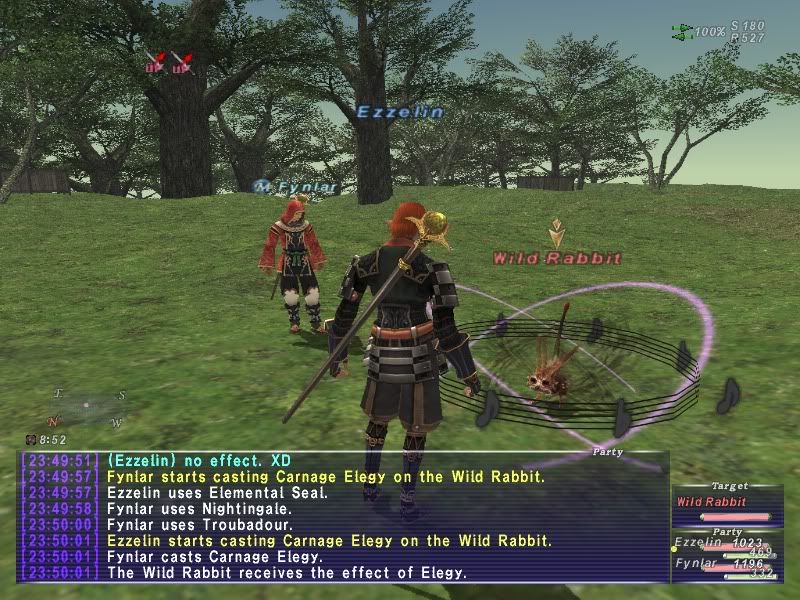
Went out and did some quick tests on Wild Rabbits in E.Ronfaure.

---
Baseline

Elegy duration in normal gear with Horn+1: ~212 seconds (so at or a little over 3:30)

Predicted duration of night/troub elegy: ~420 seconds (about 7mins).
Actual duration: ~429 seconds

---

Testing

I saw some questions about log messages regarding a non-JA elegy landing when a JA-elegy was already up on a mob. I started by casting Night/Troub Elegy on the rabbit, letting the JA's wear off, then checking the log again when casting with a normal elegy.

Final elegy duration when casting in the first half (first 200-212s) of the elegy window: 275s (4:30)

Conclusion: Non-Night/Troub elegy overwrites Night/Troub elegy (otherwise I'd have seen the longer 7:00min duration rather than the shorter 4:30 duration) -- at least if it comes from the same bard. o-o!

---

In theory, this should not happen.

A shorter-duration elegy shouldn't overwrite a longer-duration elegy, if debuff priority works the same way that buff priority does. So, I tried the test again -- this time enlisting the help of a fellow bard.


Predicted duration: ~4:30 (270s)
Actual elegy duration: ~4:44 (314s)


Conclusion
: Any bard can overwrite any other bard's elegy, regardless of remaining duration.

And then I got another friend to come out to join us, this time to test Soul Voice.


Predicted duration: ~4:30 (270s)
Actual duration: ~4:56 (296s)
Note: For this test, non-SV'd bards got 'no effect' messages against his SV'd elegy. However, he was able to overwrite his own SV Night/Troub'd Elegy with a non-Night/Troub'd (but still SV'd) elegy.

Conclusion: Soul Voice'd Elegy has priority over any other elegy, regardless of duration. However, Troub+SV elegy can be overwritten by just a normal SV elegy. Casting elegy while an SV elegy is up will result in a 'no effect' message.

---

Why This is Important


Debuff duration priority does not work the same way that buff duration priority does! A shorter duration song -- and presumably a less potent one -- can overwrite a longer duration song.

Casting elegy after someone else has, and not getting resisted, does not mean that the previous elegy was either resisted or any less potent. It just means that your elegy landed and overwrote the previous elegy. So!

To answer the question posed here:

Casting random elegies at Khimaira is probably a bad idea.

People should just be taking turns, and letting the other bards know when they get a "Khimaira's Elegy wears off" message. This ensures that only Night/Troub'd elegies (hopefully with ES!) will stay on. The last thing you want is to land an elegy that wears off 1:30 later ... when your ES/Night/Troub bard's elegy has only been on for about :30.


IMPORTANT: At the moment, I have not yet had the opportunity to test that this effect is also true on HNMs. However, I don't believe that I'll see any difference.

Wednesday, September 2, 2009

Why is my Lullaby resisted?

Common question! Here's a fun way to find the answer:

1. Are you using a horn or a harp? If horn, go to (2). If harp, go to (10).
2. Is your combined wind+singing skill more than 450? Lower than or equal to 450, go to (3), higher than 450, go to (4).
3. You probably need more +Skill. I suggest Choral Cuffs/Cannions (NQ or +1), Bard's Roundlet/Marduk Tiara, Wind Torque, Nereid Ringsx2, or Oracle's Pigaches. If you still get resists, and your combined skill is above 470 or so, go to (4) -- otherwise keep adding any skill gear.
4. Are you using a Light Staff or an Apollo's Staff? Light, go to (5), Apollo's, go to (6).
5. Get an Apollo's staff. If you're still seeing resists, go to (6).
6. Check your CHR stat. Is it in the ballpark of 110-120? If yes, go to (8), if no, go to (7).
7. Equip some more CHR gear. Kirin's Osode or Errant body is good for this. As is Gleeman's Belt, Jester's Cape +1, and the Omega Ring. If you still get resists, go to (8), if not go to (9).
8. Congratulations, you have all the gear and the stats ... but the mob is probably resistant or immune to lullaby. D: Resistant things tend to take very high levels of skill and/or CHR to lullaby reliably (480-500+ skill, roughly). Try your best!
9. Congratulations, problem solved! :D
10. Is your combined string+singing skill more than 450? Lower than or equal to 450, go to (11), higher than 450, go to (4).
11. Try adding some String skill gear. The String Torque is cheap. If you still get resists, go to (13), if not, go to (9).
12. You probably need more +Skill. I suggest stacking singing where possible. Choral Cuffs (NQ or +1) and Bard's Roundlet/Marduk Tiara offer the weightiest bonuses. If you still get resists, go to (8). If you rarely get resists now, go to (9).
13. Check your CHR stat. Is it in the ballpark of 110-120? If yes, go to (8), if no, go to (7).

---
Note: M.Acc isn't included much in the key. But it's also helpful on resist rates. Buying an Apollo's Staff has a very noticeable effect on how often your Lullaby is resisted. I always suggest upgrading to the HQ before buying any other gear.

---
Sometime in the future:
BRD on a Budget - or - What to buy if you don't buy anything else.

Friday, July 24, 2009

Haste vs. Fast Cast vs. -Songcasting

A quick summary of the separate effects:
---

Haste
*Increases melee attack speed
*Decreases spell recast timers
*Does not decrease the casting time of spells, only the recast.

Applicaton: Useful for Bard Elegy and Lullaby recast builds. Elegy recast can be a problem in very fast merit parties. You have the option to use both the stronger Carnage Elegy and the weaker Battlefield Elegy to pull in a merit situation, but I prefer to keep only the stronger elegy on my macro bar. If my elegy isn't up for whatever reason, an elemental threnody is an acceptable alternative as a pulling tool.
---

Fast Cast
*Decreases casting and recast times of all magic (Ninjutsu, Songs, Cures, etc.)
*Gear effects are typically labelled with the amount of -%Casting
Ex: 5% Fast Cast on the Royal Redingote = ~5% -Casting and ~2.5% recast

Application: This is my favorite effect to stack. Bard has a fair amount of Fast Cast gear. The Marduk's set is ~8%. /RDM has a Fast Cast Job Trait that gives ~5% at a subjob of lvl 15 and ~10% Fast Cast at lvl 30. These effects are not additive -- which means that ~10% is the best you'll get out of the Subjob.

Other available gear:
*Loq.Earring:
~2%
*Rostrum Pumps:
~2%
*Warlock's Mantle:
~2% (available as a latent effect while /RDM)
*The ACP body and the Moogle expansion hat can be potentially augmented to
~5% each. The hat, however, would take using two separate augments -- whereas the ~5% on the ACP body is contained in a single augment.
---

-Songcasting
*Calculates as part of your casting speed, only.
Ex: Minstrel's Ring and Sha'ir Manteel (Manteel has additional 2% Haste effect that applies only to recast timers)

Application: Most useful for reducing the time it takes to buff pt members. Time spent buffing is time not spent pulling, curing, or using -na spells on PT members. In combination with Job Abilities and HQ Instruments, this stat will allow you to spend as little time as possible casting buffs that last as long as possible.
---

-Song Recast
*Applies only to the recast times of songs.
Ex: Sha'ir Gages (-2 Seconds to all song recast timers) and Sheikh Gages (-4 seconds to all song recast timers)

Applicaton: The single most powerful way outside Bard JA's to reduce the recast timers of your songs. The gages are part of the Sha'ir BRD JSE set available at lvl72. The primary drawback to using the gages is losing 5 singing skill from the AF1 Choral Cuffs (and as much as 10 singing skill if they're AF+1). The general rule of thumb is to wear these when you can reliably land debuffs, and to wear the +skill when you can't. There's an (untested?) rumor that singing skill is more powerful than wind skill, which makes wearing the choral cuffs very attractive in many situations (and they're available much earlier in a bard's career).
---

Conclusions
These separate effects can be used as tools to achieve a number of desirable bard goals I'll be going over in my next post. They include:
*12-second Lullaby Recast (Applicaton: Dynamis and large links)
*12-second Finale Recast (Application: Sea Jailers, the popular Lamia No.13 Assault, etc.)
*Max -Casting gear (Application: Buffing merit parties)

I'll be treating the Bard Group2 Job Abilities in a separate post on merits.

Thursday, July 23, 2009

Site Search & Forums of Interest

If you ever have trouble searching for the information you want in a forum, use Google site search. Yes, I have it bookmarked.

It works beautifully on BG, KI, and Alla without you having to log in or be a member. Just use the domain names (helpfully linked here) and enter your search terms in the second box.

*Warning: Alla is slightly more difficult to search with this method, though you will end up in the ballpark.

Basic Numbers

Things I wish I'd known before I started playing BRD.
---

Song Durations
2:00 = No instrument
2:00 = +0 Song Instrument (ex. Storm Fife while not in Salvage or Assault)
2:30 = +2 Song Instrument (ex. Faerie Piccolo)

Conclusion: If you sing with a +0 instrument or the wrong instrument, you may as well have been singing with no instrument. The only difference is that with no instrument, you can only have one song effect up at a time. If you have no instrument, you are roughly as effective as someone /BRD.

Application: If you sing Marchx2 and Balladx2 in rapid succession, the Ballads will overwrite each other. Assuming your order was Victory March (2:30) - Advancing March (2:30) - Ballad II (2:00) - Ballad I (2:00) you, and possibly your healer if they were standing in range of march, will end up with Advancing March & Ballad I. It's safest to stick to Pianissimo+BalladII unless you're absolutely sure that your mages are out of range of melee songs. Or reverse your ballad order. But personally? I'm locked into the habit of casting BalladII first.

This is also the reason to buy March, Madrigal, and Minuet instruments if you never buy any others. If you are ever included in a swap rotation you will want the longest song duration you can get so that melee have songs for the full or nearly full duration of the swap.
---

BRD Skill
The only number that matters is Singing+Instrument. All bard songs are calculated with combined skill. The only thing that matters for buffs is the final number. Singing skill, Wind skill, and String skill are separately irrelevant. The game calculates your effect from the combined total of your numbers. If you are using a wind instrument, that number is Wind+Singing. If you are using a string instrument, that number is String+Singing.

Application: The radius of your buff songs is determined by the level of your skill. At higher levels your songs will have a wider area of effect. Some bards have string skill sets just to ballad mages in Dynamis. When discussing things with other bards, it's also helpful to know what your combined skill number is. Any time I refer to a skill number, it's understood that the number represents Singing+Instrument.
---

Valor Minuet IV Cap

Base skill at 75: 450
Needed to cap: 462 (+12)

Blade Madrigal Cap Source: Kirschy
Base skill at 75: 450
Needed to cap: 508 (+58)

Application: Functional in merit parties. Minuet and Madrigal merits will noticeably affect how your melee parse in both attack and accuracy. Consider this when you decide to merit. If you merit nothing else on bard, please consider capping minuet and unlocking Nightingale/Troubadour for swaps. These should be minimum requirements for HNM shells. Everyone should aim to hit the Valor Minuet cap, at least!

NB: These numbers assume you are using the +2 instrument. Please use the +2 instrument.
---

March Tiers - Source: BG and this Blog
NB: These numbers represent Wind Skill + Singing Skill and apply only to Victory March, which is uncapped. The effect of Advancing March is capped.

The first column represents the Haste effect, and the second represents the skill level required. Remember that these are Wind Skill + Singing Skill numbers. Base is 225 Wind + 225 Singing or 450 Skill total.

56/512 : 487-505 (Tier One)
57/512 : 506-512 (Tier Two)
58/512 : 513-532 (Tier Three)
59/512 : 533-545 (Tier Four)
60/512 : 546-552 (Tier Five)
61/512 : 553- (Tier Six)

Application: You have to be wearing +37 skill to break tier one and +56 skill to break tier two. Merits are +32 by themselves. Tier one and tier two are acceptable numbers for above-average bards. Tier four can be reached with perfect gear -Gjallarhorn. Anything above tier four requires Gjallarhorn.

Conclusion: The overall effect is, unfortunately, still tiny. Break tiers for bragging rights and slightly(?) better parses. The effect of Haste and Fast Cast stacks in a nonlinear way that resembles an exponential curve. The more of it you have, the more you get out of it.

About

For the bored, the not-quite-indifferent, and the curious among the Bards of Vana'diel -- in the hope that it might entertain, encourage, and inform.

*Address any questions to saybard@gmail.com.
*Comments are welcome on all entries.